Campaigns Don’t Lack Content. They Lack Coherence.
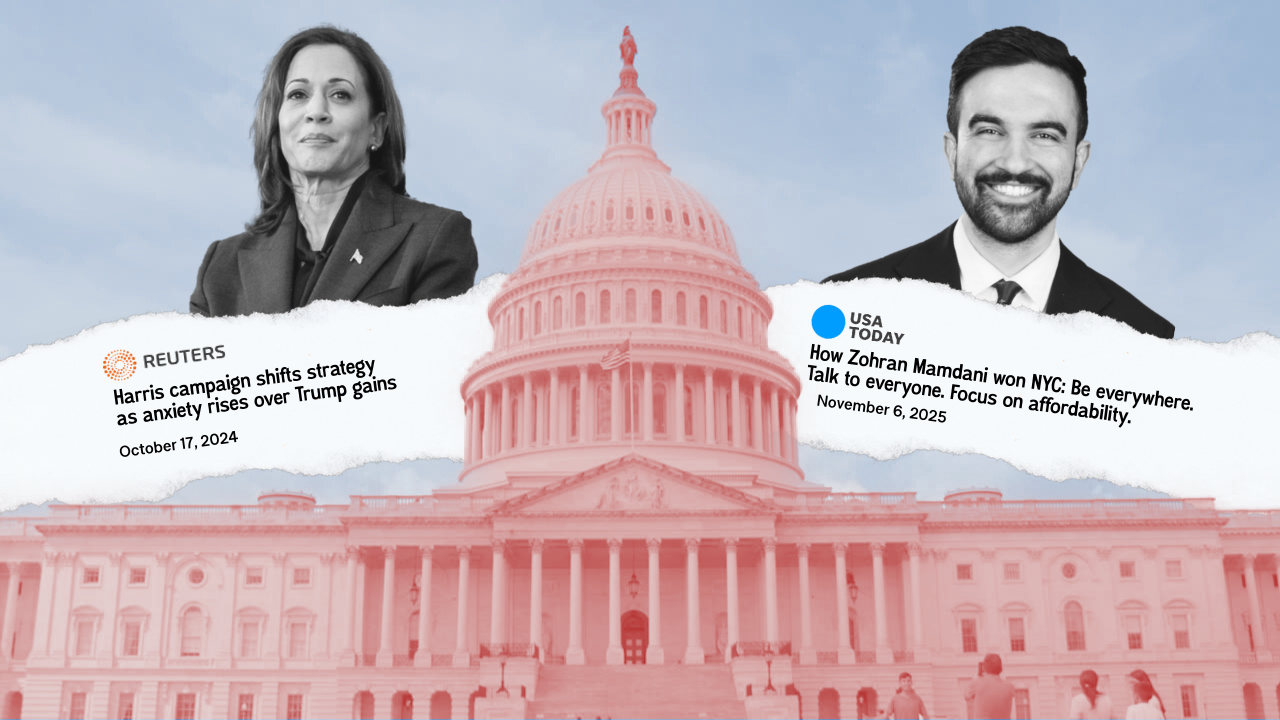
Modern digital teams can crank out assets at an impressive pace. But without a clear focus, the message splinters. Teams improvise under pressure, shifting the narrative week to week. And by October, even the best intentions get lost in the sprint.
Simply creating more content won’t win elections. Candidates need to speak to voters' pain points with clearer, more consistent messaging.
It's essential to be crystal clear on your core frame right out of the gate. The most effective narratives follow a simple pattern: lead with shared pain or frustration, then point toward a credible solution.
For many recent campaigns, that meant anchoring everything in one simple idea: affordability.
But here’s the real lesson from 2024: the question is not “What’s the magic issue?” The question is “What are voters struggling with? And how can we make them feel seen?”
And the data keeps pointing in the same direction: Authentic stories and values-based messaging outperform policy laundry lists. Real people’s stories, where the stakes are clear and human, move attitudes in ways abstract arguments don’t. PerryUndem’s longitudinal work on abortion makes that obvious.
A few cross-cutting rules show up again and again in the work that performs:
Start with the audience’s felt problem, not your internal issue list.
Use plain language. And don’t talk down to voters.
Anchor each piece in one or two shared values.
Bring in real stories with vivid stakes.
Once you have that on lock, serialized short-form video is one of the best ways to drive the issue home.
Recurring series, in simple formats or recognizable settings, are becoming essential. Because your content is not just competing against your opposition. You’re competing with Netflix, CNN, and KPop Demon Hunter.
What wins is familiarity. A consistent set, a familiar voice, a steady format, a clear style, and a coherent thread.
It’s also time to take grassroots visual culture seriously. Some of the strongest content last cycle came from leaning into camp, internet humor, and native meme energy, rather than relying solely on polished broadcast-style pieces.
And finally, there’s the budgeting problem. Too often, online spending gets squeezed toward fundraising and last-minute persuasion, while digital-first mobilization is an afterthought. The campaigns that treat digital as an ongoing narrative infrastructure — not a September tactic — keep an advantage.
Coherence isn’t a luxury. It’s the difference between shouting into the void and building a story that actually sticks.